
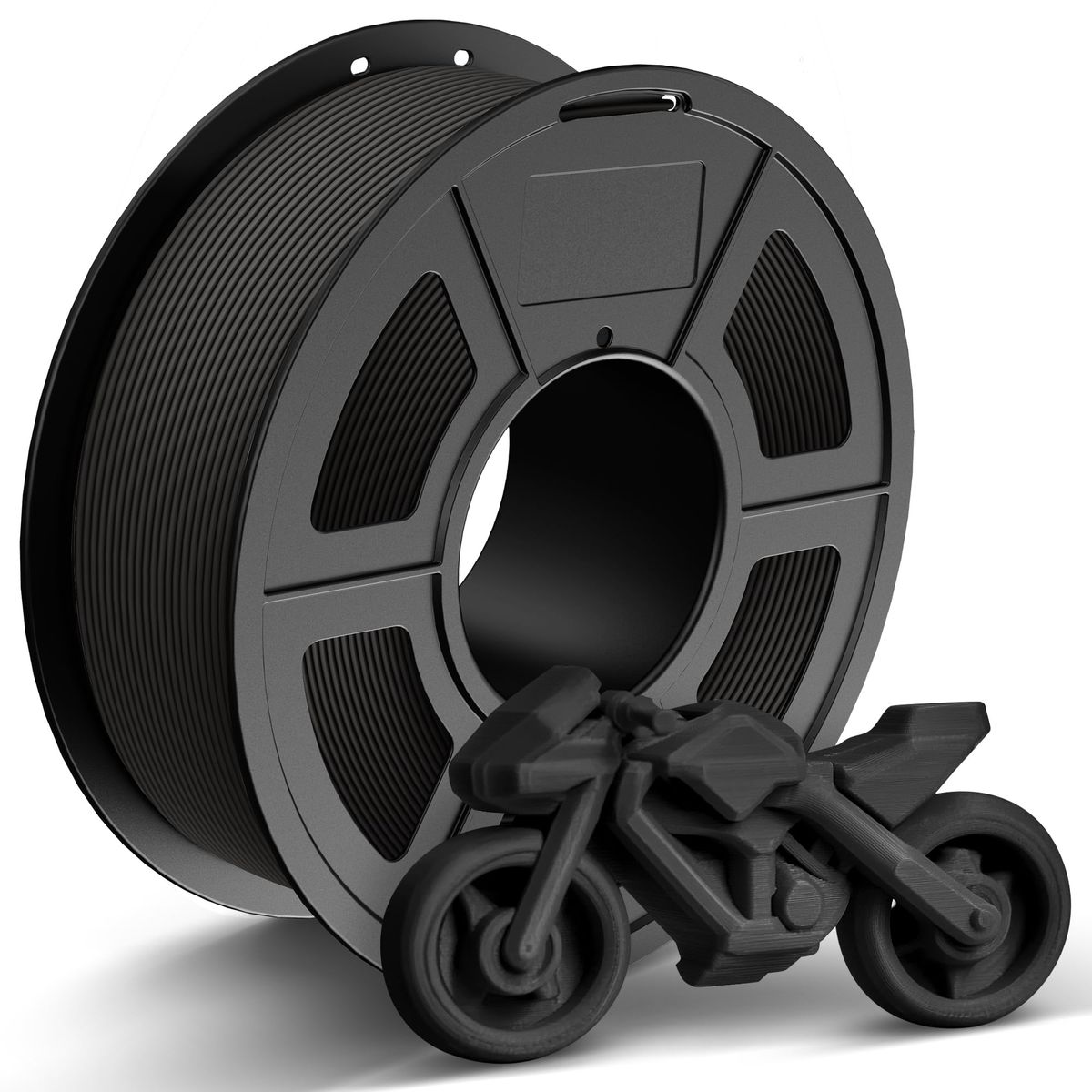
ABS Filament (Acrylonitrile Butadiene Styrene)
1. Material Properties
Strength & Durability: ABS is strong, moderately flexible, and impact-resistant, making it suitable for functional and mechanical parts like enclosures, brackets, and automotive components.
Heat Resistance: Can withstand temperatures up to ~100°C before softening, higher than PLA but lower than Nylon or Polycarbonate.
Surface Finish & Post-Processing: Smooth matte finish; easily sanded, machined, or chemically smoothed with acetone vapor.
Chemical Resistance: Resistant to many chemicals but can degrade with prolonged exposure to strong acids or bases.
2. Printing Temperature
Nozzle Temperature: 240–260°C (depends on brand and diameter)
Bed Temperature: 90–110°C to reduce warping and promote adhesion
Enclosure Recommended: Yes — prevents warping, layer splitting, and cracking by maintaining consistent ambient temperature
3. Print Considerations
Cooling: Minimal or no cooling to prevent layer adhesion issues
Warping & Shrinkage: ABS tends to warp; using rafts, brims, or enclosures helps mitigate this
Print Speed: Moderate speed 30–50 mm/s for better layer adhesion and dimensional accuracy
Layer Adhesion: Strong when printed properly, but Z-axis strength can still be lower than X/Y axes due to layer bonding
Supports: Easy to remove; sometimes sticky if printed too hot
4. Applications
Functional prototypes and mechanical parts
Automotive components
Tooling and fixtures
Electronic enclosures
5. Practical Tips
Keep filament dry, as ABS absorbs moisture which can cause bubbling and poor layer adhesion
Avoid drafts and sudden temperature changes during printing
Post-processing with acetone vapor can improve strength and surface finish
Reviews
There are no reviews yet.